
Team Building or Incentive?
Team Building and Incentive: two ideas that get confused
Training and incentive activities inside companies are more and more common. There’s still a fair amount of confusion, though, even about the most important ideas. That’s why this piece takes on the subject of team building versus incentive: what team building means, what an incentive means, how the two relate, when they meet and when they have to be kept apart.
We’ve already given several pages to explaining what team building is, telling you how to organise a team building and offering some ideas for corporate team building. So we won’t go over that ground again here, beyond a few preliminaries.
Team Building: what is it?
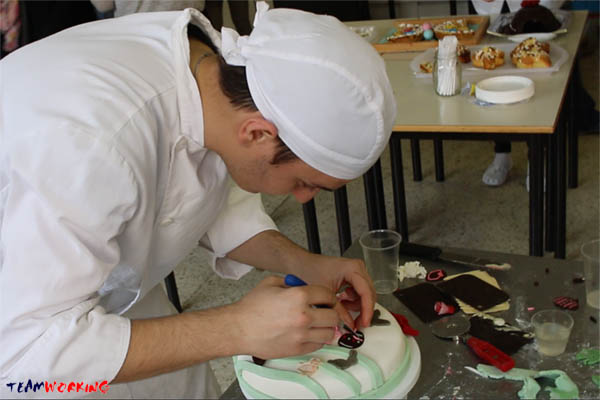
Team building means the set of activities run with groups of employees to improve the dynamics of communication and teamwork. The most recent tendency in team building is to use the instruments of what’s called experiential training. Where traditional classroom training teaches through words, experiential training teaches through real situations the participants live through.
What kind of situations does experiential training create? Every kind: from building something with your hands to a game played through the alleys of a souq, from putting a piece of music together to a challenge that only pays off if the whole group talks. What they have in common is that they take the team out of the usual office routine. That makes it possible to check, exercise and improve communication, problem solving and the way the group works together.
Outside the office walls people are more inclined to relax and to get involved, and so they discover new characteristics and abilities in themselves and in their colleagues.
Incentive: what is it?
The word incentive usually sits next to the word trip: incentive travel, incentive tour, incentive trip are the most frequent expressions. It’s a reward trip that takes the participants to a fine destination for recreational activities, meetings and training. The purpose of an incentive programme is to create a unique and exclusive experience that will stay in the memory and strengthen the emotional bond with the company.
A corporate reward trip can be reserved for:
- senior managers, whom the company wants to keep through a high-end incentive;
- salespeople being rewarded for having reached the targets the company set;
- employees among whom the company is looking for candidates for a promotion, and whom it wants to motivate to produce more;
- the most important clients, to give them a positive picture of the company and of future collaboration, present new products or services, show them where things are made, and build personal relationships alongside the working ones.
Travel agencies and team building companies in the Gulf deal constantly with incentive groups arriving from abroad. Doha is increasingly one of the places they land, and the reasons are easy to list. Hamad International is one of the busiest hubs between Europe and Asia, so most groups arrive on a direct flight. The World Cup left the city with more hotel rooms and more large venues than a place of that size would otherwise have. The country is small, so nothing is more than a short drive away and a programme doesn’t lose half a day in transfers. The winter lets you spend a whole day outdoors while half the world can’t. And for a group that has already been taken to Dubai, it is somewhere they haven’t been.
That’s why this piece talks about hosting visitors more than about accompanying local groups abroad; nothing stops you, though, from organising a trip out of the region for a Gulf group along exactly the same lines.
Incentive trip: which activities to propose?
Which activities can be part of a corporate incentive trip? In choosing, you have to allow for the fact that many participants will bring a partner or another member of the family. The purpose of building loyalty is pursued through shared experiences that leave pleasant memories. A company hopes to find more willingness later, including towards sacrifices of free time, in somebody who was rewarded with an experience they shared with their partner.
The programme has to be organised so that it’s interesting for everyone, keeps people occupied, and still leaves room for rest and above all for people to talk to each other. If the group is a large one, that balance is what a big event has to get right.
Activities tied to the company
An incentive trip often has an official part. It might be:
- A meeting or a convention
- A visit to the company’s own spaces or to a production site.
Why run a team building during a corporate meeting?
In an urban game designed as a team building the attention goes on problem solving, on effective interaction inside the team and on the contest between teams. In an incentive, the play and the culture of the place carry far more weight.
Discovering the city
An incentive programme lets the participants discover the city they’re visiting, through culture and through experiences they couldn’t book on their own. What can you propose?
The classic visits to the main landmarks, and also more original occasions. Ours is a game played on a tablet, on foot, through Souq Waqif or through Katara. The two routes are alternatives, and a group does one of them. Katara is the one to pick when the heat is a question you can’t leave open, because parts of its streets are air conditioned while still being outdoors. The souq is also where most groups do their shopping, so an afternoon there does two jobs at once.
The best known museums of the city, and the more particular or thematic exhibitions. In Doha that means the Museum of Islamic Art and the National Museum of Qatar, which are worth the trip on their own and sit a few minutes from everything else. Whether a venue will open in the evening for a private group, and on what terms, is a question to ask early: the answer changes the shape of the whole programme.
An incentive programme obviously includes lunches and dinners in good restaurants, and Doha has plenty of them, from the terraces along the Corniche to the tables upstairs in the souq. Participants arriving from abroad are usually keen to try the local cooking rather than the international menu they could have had at home.
Cultural experiences
Taking an incentive group to a concert or a performance at the Katara Opera House is the kind of evening that leaves a mark, and in the cooler months the open-air amphitheatre beside it does the same job under the sky. It suits anyone who wants an exclusive evening, whatever they usually listen to. The city’s bigger venues host international tours through the winter season: buy the tickets well ahead.
The country takes sport seriously, and the calendar is a good reason to fix the dates rather than pick them at random. A Grand Prix weekend at Lusail, a tennis tournament in Doha, a round on a championship golf course: the trip can be planned around a fixture that’s worth being there for.
When what surfaces deserves an afterwards
An activity surfaces a great deal about how a team communicates, decides and works together, and sometimes what surfaces deserves more time, more depth and a method. That is where a Team Coaching path can begin: a different road, to be taken only if it is needed, to turn what the day made visible into a new way of working together.
Let’s talk about your next team building
You don’t need to have picked a format yet. Tell us what you want your team to take home, how many of you there are and where you’ll be, and we’ll do the rest: within 24 hours you get a considered proposal for your case, with the formats that hold up against your numbers, and what each one leaves the team the day after.
Prefer to talk? · info @ teambuilding.qa